Complete Report
Appendix Tables
The share of 18- to 24-year-olds attending college in the United States hit an all-time high in October 2008, driven by a recession-era surge in enrollments at community colleges, according to a Pew Research Center analysis of newly released data from the U.S. Census Bureau.
Just under 11.5 million students, or 39.6% of all young adults ages 18 to 24, were enrolled in either a two- or four-year college in October 2008 (the most recent date for which comprehensive nationwide data are available). Both figures -- the absolute number as well as the share -- are at their highest level ever.
Enrollments have been rising over many decades at both two- and four-year colleges, but the most recent annual spike has taken place entirely at two-year colleges.
In October 2007, some 3.1 million young adults, or 10.9% of all 18- to 24-year-olds, were enrolled in a community college.1 A year later, that figure had risen to 3.4 million students, or 11.8% of all 18- to 24-year-olds. By contrast, enrollments at four-year colleges were essentially flat from 2007 to 2008.
This new peak in college enrollment has come in the midst of a recession that has driven the national unemployment rate to its highest level in more than a quarter of a century and has had an especially harsh impact on young adults. According to the Bureau of Labor Statistics, a smaller share of 16- to 24-year-olds were employed in September 2009 -- 46.1% -- than at any time since the government began collecting such data in 1948.
Community college enrollments have long been considered somewhat countercyclical; that is, they tend to rise as the economy worsens (Betts and McFarland, 1995). One reason is that community colleges are less expensive than four-year institutions -- they average $6,750 per year (including tuition, fees, and room and board) in the net price for full-time students, compared with $9,800 for four-year public colleges and $21,240 for four-year private colleges (College Board, 2009).2
Despite the higher costs of four-year institutions, their enrollments have not dropped during this recession. Rather, they have held steady -- and have been able to do so despite tuition increases averaging 4.9% per year beyond general inflation from 1999-2000 to 2009-10 at public four-year colleges and universities (College Board, 2009).
Changes in the labor market and the overall economy are not the only factors that affect college enrollment levels. Another important factor is the rate at which young adults complete high school. Here, too, Census Bureau data show that a new milestone has been reached.
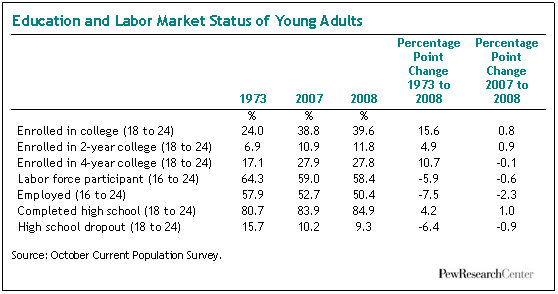
According to census figures, a record 84.9% of 18- to 24-year-olds had completed high school as of October 2008, up from 75.5% in 1967 and 83.9% in 2007. Along these same lines, there is a record low in the share of young adults who are high school dropouts -- 9.3% in 2008, less than half the figure (19.8%) in 1967 and down nearly a percentage point from 10.2.% in 2007.
This report is primarily based on the Pew Research Center's analysis of the October 2008 Current Population Survey and Census Bureau's historical time series on college enrollment available on the Census Bureau’s website. The charts were prepared by research associate Wendy Wang. The historical tables in the Appendix were formatted by research assistant Daniel Dockterman. Paul Taylor, director of the Pew Research Center's Social & Demographic Trends project, provided editorial guidance and wrote the overview. Senior researcher Rakesh Kochhar provided helpful insights on the use of the Current Population Survey. Research analyst Gabriel Velasco did the number checking, and Marcia Kramer copy-edited the report.
Newly released Census Bureau data indicate that college enrollment among 18- to 24 year-olds reached an all-time high last year. In October 2008, 39.6% of 18- to 24-year-olds were in college (Figure 1), an increase from 38.8% in October 2007 and 24.0% in October 1973.3 The relatively high proportion of young adults attending college is due to a recent spike in enrollments at two-year colleges. In October 2008 11.8% of 18- to 24-year-olds were enrolled in two-year colleges, the highest figure for two-year college attendance among that age group on record. In October 2008, 27.8% of 18- to 24-year-olds were enrolled in four-year colleges. This was unchanged from October 2007 (27.9%) and below the October 2005 peak (29.2%).
Among 18- to 24-year-olds, two-year colleges educated about 30% of college students in October 2008, not much different from the 29% share they educated in 1973.

The size of the total 18- to 24-year-old population in 2008 (29 million) was close to its all-time high attained in 1981,4 so the high college enrollment rate in 2008 also led to a record in the absolute number of young adults attending college. Almost 11.5 million 18- to 24-year-olds were enrolled in college in 2008, the highest figure ever (Appendix Table A1).5
This peak in college enrollment is occurring concurrently with difficult labor market prospects facing youths. Recent news accounts have noted that the employment rate among 16- to 24-year-olds is at its lowest level since the government began collecting the data in 1948. And labor force participation for that age group is at its lowest level since at least 1970.
Further analysis is needed to determine the extent to which the recent increase in community college enrollment among 18- to 24-year-olds is explicitly related to the current recession, which officially began in December 2007. Previous research has shown that community college enrollments tend to rise as labor market conditions deteriorate and unemployment rates rise (Betts and McFarland, 1995). But recent movements in both college enrollment and labor force participation might also reflect longer-running trends. College enrollment among youth has been rising since 1980 (Turner, 2004), and labor force participation among younger people has been declining since the mid-1980s (Juhn and Potter, 2006). Moreover, schooling and work are not mutually exclusive endeavors. About half of young full-time college students are either working or looking for work.
The record share of 18- to 24-year-olds attending college in 2008 comes at a time when a record proportion of young adults have completed high school, either by regular high school graduation or passing an equivalency test. According to Census Bureau figures, in October 2008, almost 85% of 18- to 24-year-olds had completed high school, an all-time high for this basic measure of educational attainment (Figure 2) and up from 75.5% in 1967. Thus, more youths than ever before were eligible to attend college (most college students have finished high school). Another factor that could account for the greater share of 18- to 24-year-olds attending college could be an increase in the rate of college attendance among those who have finished high school. However, this did not occur in October 2008. The measured college enrollment rate of 18- to 24-year-old high school completers was 46.7% in 2008, slightly below the peak attained for this measure in 2005 (46.9%). Effectively, a record high proportion of youths are in college because the base of young high school completers is at an all-time high, not because college enrollment among high school-educated youth has increased.
Census figures also indicate that a record low share6 of 18- to 24-year-olds were high school dropouts in 2008 (Figure 2). In October 2008, 9.3% of 18- to 24-year-olds were high school dropouts -- less than half the 19.8% of 18- to 24-year-olds who were high school dropouts in 1967.7

Since 1987 women have been a majority of 18- to 24-year-olds attending college. As of October 2008, women comprised 53% of all young college students.8
Notwithstanding that trend by gender, the percentage of 18- to 24-year-old men enrolled in college reached an all-time high in October 2008 (37.0%) (Figure 3). For many years, young men's college participation had remained below the level reached during the height of the Vietnam War (35.2% in October 1969), when many male students extended their education because they wanted to hang on to their student deferment from the military draft. Not until October 2005 did college enrollment among young men surpass the October 1969 level. It has kept rising since then.

In October 2008, a larger share of 18- to 24-year-old women were enrolled in college (42.3%) than their male counterparts (37%), but young female college enrollment was not much different than its October 2005 peak (42.5%)
White youths attained several educational milestones in 2008 (Figure 4).9 Nearly 41% of white 18- to 24-year-olds were enrolled in college in 2008, an all-time high. This is partly accounted for by the relatively high levels of high school completion attained by white 18- to 24-year-olds in 2008. Nearly 86% of white youths completed high school (by either receiving a high school diploma or high school equivalency) in 2008, an all-time high. There were fewer white high school dropouts than ever before, and the white high school dropout rate reached an all-time low in 2008. The absolute number of white 18- to 24-year-olds who were not enrolled and had not completed high school fell below 2 million for the first time. The white high school dropout rate also fell under 9% for the first time in 2008.

About 26% of Hispanic 18- to 24-year-olds were enrolled in college in 2008 (Figure 5). This level did not surpass the 2007 young Hispanic college enrollment rate and trailed the white young college enrollment rate by nearly 15 percentage points. However, more Hispanic 18- to 24-year-olds had completed high school (70%) than ever before. And the Hispanic high school dropout rate among 18- to 24-year-olds continued its downward march in 2008. In 2008, 22% of Hispanic 18- to 24-year-olds were high school dropouts, the lowest rate on record.10

Black college enrollment among 18- to 24-year-olds in 2008 (32%) did not surpass the 2007 level (33%) (Figure 6). The high school completion rate of 18- to 24-year-old blacks in 2008 was lower than 2007, and the black high school dropout rate for 18- to 24-year-olds in 2008 was higher than in 2007.

The U.S. Census Bureau's reports on college enrollment rely on the bureau's supplement to the October Current Population Survey (CPS). The October 2009 CPS supplement is being processed. It will not be publicly available for many months, and thus it is impossible to know definitively how the 2009 levels of college enrollment compare with 2008 and earlier years.
However, each month the Census Bureau collects more limited information on school enrollment in its basic monthly questionnaire. The share of 18- to 24-year-olds enrolled in college can be estimated each month from the basic questionnaire. College enrollment is seasonal, and hence comparison of enrollment across different months reflect that seasonality.
College enrollment estimates based on the September 2009 CPS suggest that enrollment among 18- to 24-year-olds has not decreased from its 2008 peak. In September 2009, 39.9% of 18- to 24-year-olds were enrolled in college. In comparison, 38.6% of 18- to 24-year-olds were enrolled in college in September 2008. Hence, early indications suggest that 2009 college enrollment for 18- to 24-year-olds at a minimum continues at the high levels of college enrollment measured for 2008.
1. Technically, not all two-year colleges are “community colleges.” But 96% of 18- to 24-year-olds enrolled in two-year colleges are enrolled in community colleges, so this report refers to two-year colleges as community colleges.
2. The net price refers to the published tuition, fees and room and board and then deducts grant aid from all sources and federal tax benefits. Financial aid in the form of loans to students or parents is not subtracted.
3. 1973 is the earliest year in which the split of college enrollment between two-year enrollment and four-year enrollment is available in the historical time series. See Table 204 of the National Center for Education Statistics (2009a).
4. The universe for the Current Population Survey is the civilian non-institutional population. The figures for the numbers of 18- to 24-year-olds refer to those in the civilian non-institutional population.
5. The National Center for Education Statistics, as part of its Integrated Postsecondary Education Data System (IPEDS), tabulates fall enrollment in degree-granting institutions from its survey of the nation’s college and universities. The latest figures available are October 2007. The count of 18- to 24-year-olds enrolled in degree-granting institutions in October 2007 is 10.6 million. This compares to college enrollment of 11.2 million based on the October 2007 Current Population Survey.
6. The status high school dropout rate refers to the percent of the population that has not completed high school and is not enrolled in school. As many analysts have noted, some high school dropouts were never enrolled in school in the United States and left school in their country of origin before migrating to the United States.
7. Again, these rates refer to 18- to 24-year-olds in the civilian non-institutional population. Thus, they might overstate the decline in the fraction of youths who are high school dropouts. A larger share of 18- to 24-year-olds were institutionalized in 2008 than 1967, and high school dropouts are much more likely to be institutionalized than other youth. Nonetheless, high school dropout rates calculated using all youths, not just those in the civilian non-institutionalized population, still show a marked decline in dropout status over the past 40 years (Fry, 2009).
8. Among college students of all ages, women became the majority of undergraduate college students in 1979 and the majority of graduate students in 1990 (Census Bureau, 2008).
9. In this report, “white” refers to any person reporting white racial identity regardless of his or her Hispanic origin. The longest running Census Bureau historical time series on white college enrollment includes Hispanics and non-Hispanics. It should also be noted that the historical series on the “white alone” population has a break in 2003. Beginning in 2003, respondents in the Current Population Survey could identify more than one race. The “white alone” category from 2003 onward refers to respondents of only white racial identity. Hence, the figures for “white alone” persons before 2003 may not be entirely comparable to figures for 2003 and thereafter.
10. The U.S. Department of Education, on the basis of the same Census Bureau data utilized in this report, tabulates Hispanic high school dropout rates for 16- to 24-year-olds (NCES, 2009b). It finds that the Hispanic high school dropout rate has been trending downward since 1990.
Recession Turns a Graying Office Grayer - 3 Sep 09
Women Call the Shots at Home; Public Mixed on Gender Roles in Jobs - 25 Sep 08
Men or Women: Who’s the Better Leader? - 25 Aug 08
You're Laid Off - 16 Apr 08
Inside the Middle Class: Bad Times Hit the Good Life - 9 Apr 08
Fewer Mothers Prefer Full-time Work - 12 Jul 07
Working After Retirement: The Gap Between Expectations and Reality - 21 Sep 06
Americans See Less Progress on Their Ladder of Life - 14 Sep 06
American Work Life is Worsening, But Most Workers Still Content - 30 Aug 06