Download the complete report
Overview and Executive Summary
Section I: A Self Portrait
Section II: A Statistical Portrait
This report on the attitudes and lives of the American middle class combines results of a new Pew Research Center national public opinion survey with the center's analysis of relevant economic and demographic trend data from the Census Bureau. Among its key findings:
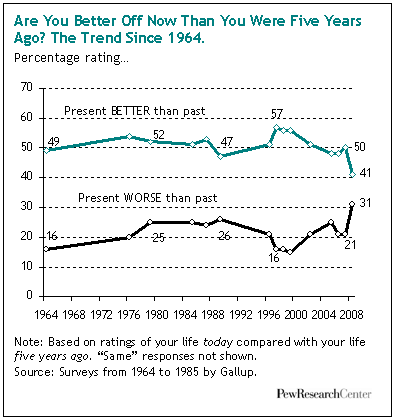
Fewer Americans now than at any time in the past half century believe they're moving forward in life.
Americans feel stuck in their tracks. A majority of survey respondents say that in the past five years, they either haven't moved forward in life (25%) or have fallen backward (31%). This is the most downbeat short-term assessment of personal progress in nearly half a century of polling by the Pew Research Center and the Gallup organization.
For decades, middle income Americans had been making absolute progress while enduring relative decline. But since 1999, they have not made economic progress.
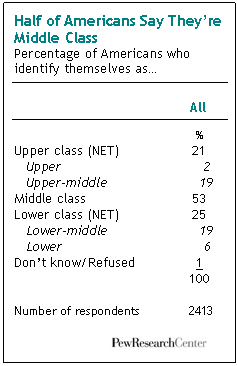
About half of all Americans think of themselves as middle class. They are a varied lot.
For the past two decades middle income Americans have been spending more and borrowing more. Housing has been the key driver of both trends.
At a time when these borrow-and-spend habits have spread, Americans say it has become harder to sustain a middle class lifestyle.
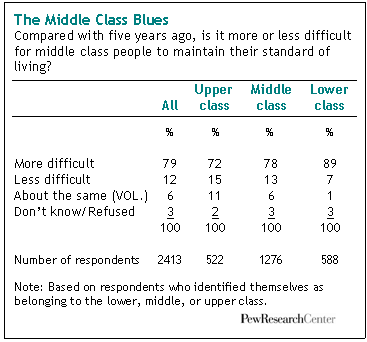
Nearly eight-in-ten (79%) respondents in the Pew Research Center survey say it is more difficult now than five years ago for people in the middle class to maintain their standard of living. Back in 1986, just 65% of the public felt this way.
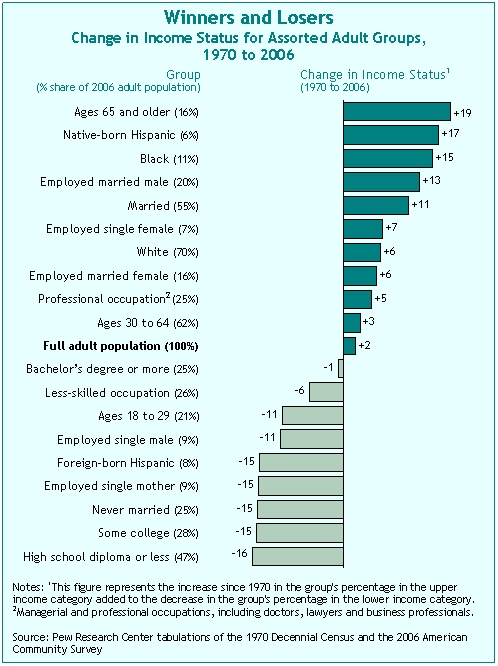
Economic, demographic, technological and sociological changes since 1970 have moved some groups up the income ladder and pushed others down.

Most middle class adults agree with the old saw that the Republican Party favors the rich while the Democratic Party favors the middle class and the poor.
Most Americans feel stuck in their tracks. A majority of adults in this country say that in the past five years they either haven't moved ahead in life or have fallen backwards. This is the most downbeat assessment of personal progress in nearly a half century of polling by the Pew Research Center and the Gallup Organization.
People feel this way for a reason. Median annual household income in the United States -- arguably the best single measure of a middle class standard of living -- is below the peak it reached in 1999, after adjusting for inflation.1 This has been one of the longest slumps for this key indicator in modern U.S. history. And the pain has not been spread evenly. Those in the upper income tier have done better than those in the middle and lower tiers -- not just during this decade's downturn, but through good times and bad stretching back to the early 1970s.
These two trends -- a recent decline in standard of living, coming on top of a long-term rise in income inequality -- have conspired to produce the economic malaise characterized by candidates and commentators alike during this presidential campaign season as "the middle class squeeze."
There's no denying that the phrase strikes a chord with the American public. According to a new Pew Research Center survey, about eight-in-ten (79%) adults say it is more difficult now than it was five years ago for middle class people to maintain their standard of living. Two decades ago, just 65% felt this way, according to a 1986 NBC/Wall Street Journal poll.
Nonetheless, these downbeat appraisals -- both of personal progress and of middle class well-being in general -- are not the public's only perspectives on this matter. Despite their short-term sense of stagnation, most Americans see in the sweep of their lives a long arc of progress. Nearly two-thirds (65%) say they have already exceeded the standard of living that their parents had at the age they are now. Most expect to face some belt-tightening -- or worse -- in the coming year, but a majority is confident that their quality of life in five years will be significantly better than it is now. And, gazing into a more distant future, most expect their children's standard of living to be better than their own.
In short, the public is beleaguered but unbowed. And its positive long-term perspective, like its negative short-term assessment, is in line with underlying economic realities. Despite the downturn of the current decade, median household income increased by 41% from 1970 to 2006 (the last year for which such data are available), after adjusting for inflation and changes in household size. To be sure, the rising tide favored some boats over others. The income gains over this period were greater for upper income adults than for middle or low income adults, and the wealth gains were much greater in the top income tiers than in the middle or at the bottom. So for those in the middle peering upward, absolute progress has gone hand in hand with relative decline.
All of these economic trends -- stagnation in the short term, rising prosperity and rising inequality in the long term -- provide a context for the nuances of public opinion on the subject of the "squeeze." When survey respondents say they haven't moved forward in recent years, the economic data say they're right. When respondents say they're doing better than their parents, the economic data say they're right. When respondents say it has become more difficult to maintain a middle class standard of living, the data once again say they're right -- if what they mean is that it has become harder for people in the middle to keep pace with those above them.
Through the Looking Glass of Class
To examine the dynamics of public opinion through the prism of socioeconomic class, the survey asked respondents to place themselves into one of five groups -- upper class, upper middle class, middle class, lower middle class and lower class. About half (53%) say they are middle class; some 19% percent say they are upper middle class and another 19% say they are lower middle class; 6% say they are lower class and 2% say they are upper class.2
One overarching finding from this exercise in self-identification is that class divides people far more by their economic experiences and characteristics than it does by their social values and life priorities, their demographic traits or their evaluations of their own quality of life and economic mobility.
For example, the percentage of people who say they "live comfortably" ranges from 66% of the self-defined upper class to 39% of the self-defined middle class to just 9% of the self-defined lower class. But the range is not nearly as wide when respondents are asked whether they're doing better in life than their parents; some 80% of the upper class say they are, compared with 67% of the middle class and 49% of the lower class. And the class disparities grow smaller on questions about life priorities. For example, 66% in the upper class say it is important to be wealthy, compared with 55% in the middle class and 51% in the lower class. On the demographic front, class disparities are fairly wide with regard to education and less wide with regard to homeownership and marriage.
On virtually every topic explored in this survey, responses of the middle class fall between those of the upper and lower classes -- but sometimes the middle leans toward the bottom, and sometimes toward the top. This report will examine the attitudes, aspirations and anxieties of America's middle class in detail -- and it will also explore the economic and demographic realities that underlie them. It will focus on changes in the middle class since 1970; on differences among the middle, lower and upper income groups; and on the wide range of experiences, opinions and values within the middle class itself.
Before summarizing our findings, a note about terminology. Throughout the report, when we refer to the "middle class" we are describing the 53% of adults who identified themselves that way in response to a question in our survey. When we refer to those who are "middle income," we are describing the 35% of adults who live in a household where the annual income falls within 75% to 150% of the national median (a standard yardstick in economic literature about income dispersion). The disparity in the size of these two "middles" underscores one of the themes of this report: that being middle class is a state of mind as well as a statement of income and wealth.
Section I focuses on the "middle class" and relies on the public opinion survey findings. Section II focuses on the "middle income" and relies on the U.S. census and other relevant data sources. The remainder of this overview presents key findings from both sections.
Just over half of adult Americans consider themselves middle class. They are a varied lot.
Asked to place themselves into one of five socioeconomic categories, just over half (53%) of adults in our survey describe themselves as middle class, a finding that has varied very little over many decades of social science survey research.3 On most key components of social and economic status -- such as income, wealth, health, education, homeownership -- the survey finds the self-defined middle class is truly in the middle, positioned between those who identify with the classes above and below them. But even within this self-defined middle class, there are notable economic and demographic differences. For example, younger adults and older adults are both more likely than middle-aged adults to describe themselves as middle class, even though their income levels are lower. Meantime, middle-aged middle class adults are more likely than those who are younger and older to report financial stresses, even though they have more income. Also, roughly the same percentages of whites (53%), blacks (50%) and Hispanics (54%) self-identify as middle class, despite the fact that the income and wealth of blacks and Hispanics who say they are middle class is much lower than that of whites who say they are middle class.
Middle class Americans - and all Americans - feel less progress in their lives now than at any time in at least 44 years.
On a scale of zero to ten, survey respondents were asked to give a numerical rating to their present quality of life, then to use the same scale to rate the life they led five years ago and finally to rate the life they expect to lead five years from now. More than half rate their life today either worse (31%) than their life five years ago or the same (25%). Just 41% say their life today is better. In the 44 years that these "ladder of life" questions have been asked in Pew and Gallup surveys, these are the most bearish ratings ever recorded. Not surprisingly, there is a class-based pattern to the public's judgments. The self-defined lower classes are the most discouraged about their recent progress (44% rate their life today below their life five years ago); the self-defined upper classes are the least discouraged (just 22% rate their life today below their life five years ago); while the self-defined middle class is situated between the two groups, but closer to the top than the bottom (28% rate their life today below their life five years ago).
Most people in the middle class feel they've exceeded their parents' standard of living.
When the middle class lengthens its time horizons, it elevates its assessment of personal progress. Two-thirds (67%) say their standard of living is better than the one their parents had at the age they are now. Just 10% say their standard of living is worse. In these judgments, the middle class is less upbeat than those in the upper classes (80% of whom say they're doing better than their parents) and more upbeat than those in the lower classes (49% of whom say they're doing better than their parents). Many of these differences between the classes wash away when people are asked about their expectations for the next generation. Roughly half of respondents in all three classes say they expect their children's standard of living to exceed their own. However, a significantly larger share of those in the lower class (31%) than of those in the upper (17%) or middle (19%) classes say they think their children's lives will be worse than theirs. A greater share in the latter two groups say that they expect their children to do about the same in life as they themselves have done.
The vast majority of middle class adults say it has become harder to maintain a middle class lifestyle. But most of them think they themselves are beating the odds.
Just 28% of middle class respondents say they've fallen backward in life in the past five years. But a lopsided majority (78%) says it has become more difficult over the past five years for people who are middle class to maintain their standard of living. These responses suggest that most middle class adults think of themselves as at least holding their own against daunting odds. The widespread perception that it is harder now than it was five years ago to maintain a middle class standard of living is not class-based. Large majorities of all three classes (72% upper; 78% middle; 89% lower) share this view.
There is nothing approaching a consensus about who or what is responsible for the middle class squeeze.
Nearly everyone agrees that it's become harder to maintain a middle class lifestyle, but there's no consensus about who or what is mostly to blame. Among middle class respondents, about a quarter (26%) blame the government, 15% blame the price of oil, 11% blame the people themselves, 8% blame foreign competition, 5% blame private corporations and the rest cite other factors or do not have an answer. Within the middle class, big differences on this question occur along partisan lines. Democrats are most likely to point the finger at government (35% do so) while Republicans divide blame among the people (17%), the government (16%) and the price of oil (16%).There are also class divisions on this question, with the lower class nearly twice as likely as the upper class to blame the government (39% versus 21%).

Within the middle class, there's a wide range of financial circumstances and anxieties.
Fully four-in-ten Americans with family incomes below $20,000 say they are middle class, as do a third of those with incomes of $150,000 or more. Not surprisingly -- given this broad range -- some in the middle class (39%) report that they are financially comfortable, while 37% say they "have a little left over after meeting expenses" and 20% say they "just meet expenses." Only 3% say they can't meet expenses. Asked about their financial experiences in the past year, more than half of middle class adults report that they've had to tighten their belts. Half also expect that they will have to cut more spending in the year ahead. Among those in the middle class who are employed, about a quarter (25%) worry that they could be laid off, that their job could be outsourced, or that their employer could relocate in the coming year, and a bit more (26%) worry that they could suffer a cutback in salary or health benefits.
Keeping up with the Joneses: Americans have a finely calibrated sense of how much money it takes to live a middle class lifestyle in their area. But they tend to overestimate how many people have certain high-end goods and services.
When we asked respondents to estimate how much money it takes for a family of four to live a middle class lifestyle in their community, the median of all responses was $70,000 -- uncannily close to the Center's national estimate, based on Census Bureau data, of $68,698 a year for a four-person household.4 However, when we presented respondents with a list of high-end consumer goods and services, and asked whether they have them and whether they believe most other people have them, their tendency in some cases was to over-estimate what most other families have. For example, more than six-in-ten (62%) believe say that most families have a high definition television, whereas just 42% of all adults say that their family has one. Similarly, about a quarter (24%) of respondents believe that most people have a child in private school, though only 15% of parents with school age children report having a child in private school. Lopsided majorities also believe that most families have cable or satellite service, two or more cars, and high speed internet access. In these judgments, they are correct -- a majority of families report that they do in fact have these goods and services.
Everything is relative: People's estimates of the price of admission to a middle class lifestyle rises with their own income levels and with the cost of living in their own communities.
There's a strong correlation between respondents' family income and their estimate of what it takes to lead a middle class lifestyle. The greater the income, the higher the estimate. Adults in families whose income is between $100,000 and $150,000 a year believe, on average, that it takes $80,000 to live a middle class life in their area. By contrast, adults in families whose income is less than $30,000 a year believe that a middle class lifestyle can be had for about $50,000 a year. Analyzing these estimates by the ZIP codes of the respondents yields a similar finding: that people who live in communities with a high cost of living think it takes, on average, about $15,000 more to be in the middle class than do people who live in communities with a low cost of living.
Asked to weigh their priorities in life, the middle class puts time ahead of wealth -- and everything else.
Some two-thirds (68%) of middle class respondents say that "having enough free time to do the things you want" is a very important priority in their lives. That's more than say the same about any other priority we asked about in this survey including: having children (62% said that is very important), being successful in a career (59%), being married (55%), living a religious life (53%), doing volunteer work/donating to charity (52%); and being wealthy (12%). Upper and lower class respondents give essentially the same answers. The demographic groups most inclined to say they highly value free time are the ones least likely to have it -- such as the employed, the middle-aged, and mothers of young children. In recent years, a number of public opinion surveys have documented Americans' growing sense of feeling rushed, and this perception tracks with the growth in the number of mothers who are employed outside the home and in the number of two-earner couples. However, recent research on whether Americans in fact have less leisure time has produced mixed findings. At least one major report, which relied on five decades of time use logs kept by different groups of survey respondents, found that no matter what most people may perceive, Americans today have more leisure time now than they did several decades ago.5 Other reports find that many middle class families have maintained their lifestyle only by becoming two-earner households, with all the attendant time stresses.6
Most middle class Americans believe that the rich just keep getting richer, but they don't have a settled view about how the rich become rich.
Two thirds of people in the middle class agree with the proposition that the rich are getting richer and the poor are getting poorer. But they're split in their explanations about how the rich become rich. Some 47% say it's mainly the result of having good connections or being born into it, while 42% say it's mainly the result of hard work, ambition and education. Not surprisingly, those in the upper classes (56%) are more inclined to cite hard work, ambition and education than are those in the middle (42%) or lower (32%) classes. Class divisions also are apparent on a related question about whether success in life is determined by forces outside one's control. Majorities of all three classes disagree with that proposition, with a greater share of the upper class disagreeing (69%) than of the middle (62%) or lower (51%) classes.
Since 1970, the middle income tier in America has shrunk by about 5 percentage points.
In 1970, 40% of all adults in this country lived in a middle income household, with "middle" defined as one where the income falls within 75% to 150% of the median. By 2006, just 35% of adults were in the middle income tier. This small but notable hollowing out of the middle has been accompanied by an increase in the share of adults in both the lower income category and the upper income category. The rise in share has been greater over this time period for the upper group (to 32% in 2006 from 28% in 1970) than for the lower income tier (to 33% in 2006 from 31% in 1970). Looking at these changes by age group shows that the trends have been very different for the youngest and oldest adults. The 65 and older group has moved ahead during the past 36 years; the 18-to-29 year old group has fallen behind. Among the older group, just 45% were in the lower income tier in 2006, down from 58% in 1970. Among the younger group, 39% were lower income in 2006, up from 30% in 1970.

Some demographic groups have improved their income status since 1970; others have fallen behind.
The period since 1970 has seen a distinct sorting of many different demographic groups into different income tiers. In addition to the elderly, the groups that have gained the most include blacks and native-born Hispanics. Married adults have also done well, while the never-married have fallen behind. On the gender front, men and women have moved in different directions, depending on marital and work status. Working husbands and working wives both have seen their income positions improve since 1970, but the gains have been greater for working husbands. Among those who are not married, the gender pattern is reversed: single working women's income position has improved since 1970, while single working men's income position has declined. Other groups that have not fared well are young adults, people in lower-skilled jobs, people with less educational attainment, and immigrant Hispanics. The decline for this last group is mainly the result of a heavy influx of low-skilled immigrants, rather than downward mobility among immigrants already in the U.S.
Since 1970, the middle income tier has gotten older, better educated, less likely to be white and less likely to be married.
Demographic changes in the middle income tier since 1970 are very similar to the changes in the U.S. adult population as a whole. The average age for middle income adults was 45 in 2006, up from 41 in 1970 (comparable figures for the full adult population are 46 in 2006 and 44 in 1970). In 1970, 88% of the middle income group was white; by 2006, just 71% was white (comparable figures for the full adult population are 86% in 1970 and 70% in 2006). The ethnic group that moved heavily into the middle income tier during this period was Hispanics: In 1970, they made up just 3% of the middle tier; by 2006, they were 13%. In 1970, more than three-quarters (76%) of the middle income group were married; by 2006, just 57% were married. But the biggest demographic change has come in levels of educational attainment. In 1970, just one-in-five middle income adults had at least some college education; by 2006, more than half did. As noted on the previous page, never married adults and those with less educational attainment have been among the groups suffering the biggest losses in income status over this period.
Since 1969, median household income has risen for all Americans. But it has not risen as much for the middle income group as for the lower and upper income groups.
From 1969 through 2006, median annual household income increased by 41%, after adjusting for the decline in household size.8 However, the rise was greater for the upper income tier (50%) than for the middle (40%) or lower (42%) tier. By 2006, the median income of the upper group was $128,040, about double the $63,955 median income of the middle group and about five times the $25,201 median income of the lower group. This long-term increase in income inequality is more pronounced when one focuses on the top 1%, 5% or 10% of U.S. households. Each of these high-end groups has pulled farther away from the group just below it.9
The growth in median family income has been slower and more skewed to upper income groups since 1973 than it had been in earlier decades.
When looking at changes over time in the standard of living of the American public, economists often divide the past six decades into two eras. The period from 1947-73 was characterized by robust average annual increases for all income tiers, as well as a modest decline in income inequality. The period since 1973 has been characterized by much slower growth for all groups, and also by an increase in income inequality. In the first era, the average annual growth rate in family income exceeded 2.5% in all income quintiles -- and the growth was slightly higher in the lower quintiles than in the upper quintiles. In the second era, the average annual growth rate was much lower for all quintiles, but it was much higher in the upper quintiles than in the lower quintiles.
Since 1999, all income groups have seen their real incomes decline.
Since hitting a peak in 1999, median household income has declined for all three income groups. On a percentage basis, the decline from 1999 to 2006 has been slightly greater for the lower income group (5%) than for the middle income group (3%) or the upper income group (2%). This is one of the longest periods in modern history in which this key economic indicator has not returned to an earlier peak -- although the trend in recent decades has been toward protracted but shallow declines following periods of growth. Should the economy fall into a new recession -- as many economists now predict -- the current downturn would become the longest in modern history.
Median family wealth has grown in recent decades. The biggest gains by far have been made by those in upper income groups.
The median net worth of families (all assets minus all debt) has risen by 50% over the past two decades, from $69,902 in 1983 to $104,645 in 2004 (all figures inflation-adjusted to 2008 dollars). But this growth has been spread unevenly through the income tiers. For the top income group, median family wealth has more than doubled during this time period, rising by 123% to $439,390 in 2004. For the middle income group, median wealth increased by only 29%, rising to $98,286 in 2004. For the lower income group, median wealth increased by just 24%, rising to $16,000 in 2004.
As Americans have seen the values of their homes rise over the past two decades, they have increased the size of their debt. This is especially true for those in the middle income group.
In every way that can be measured -- size, value, source of wealth, collateral for debt -- the American home bulks larger than ever in the economic life of the middle class (and the nation as whole). A new single-family home is about 50% bigger today than a new home was a generation ago. The median sales price of existing single-family homes has risen in inflation-adjusted dollars from $142,578 in 1983 to $223,362 in 2007.10 However, while homeowners have seen the value of their biggest asset rise sharply, they have also leveraged their homes to take out ever more debt. This is especially true for middle income families, whose overall debt-to-asset ratio rose from .25 in 1983 to .40 in 2004. Their increase in debt burden was much greater than that of the upper income group (it rose from 0.21 in 1983 to 0.27 in 2004) and slightly greater than that of the lower income group (for whom it rose from 0.29 in 1983 to 0.42 in 2004). For middle income families, 78% of their increase in debt between 1983 and 2004 was due to debt secured by their primary residence.
Since 1980, expenditure levels have risen for all three income tiers, but they have risen the most for the upper tier. Families in all tiers have changed the mix of where they spend their money.
As with income and wealth, consumer expenditures have risen for all three tiers from 1980 to 2006, but the growth in spending has been greater for the upper tier (32%) than for the middle (15%) or lower (16%) tiers. Looking just at the current decade, expenditures continued to rise for all three income tiers, while incomes have declined during this period, suggesting that families have been financing their lifestyles in this decade by more borrowing or less saving, or both.
Patterns of expenditures have changed as well. Over the course of those two and a half decades, families in all three tiers are devoting proportionately more of their budgets to housing, pensions, medical care, and education; and less to recreation, transportation, food and clothing.
There is a great deal of short-term economic mobility among individuals in the middle income bracket.
A 2007 study by the U.S. Treasury Department found that about half of all taxpayers are in a different income quintile from the one they had been in a decade earlier. It also found that the highest levels of churn occur in the middle income brackets. The chart below illustrates, for two consecutive nine-year periods, where taxpayers who were in the middle income quintile at one point in time wound up nine years later. It shows that, in each time period, roughly two-thirds of the middle quintile taxpayers were in a different quintile after nine years. (It should be noted that the skew toward upward mobility reflected in this chart is due in part to a life cycle effect; at least through late middle age, adults tend to earn more as they age). The chart below offers one explanation for the Pew survey finding that individuals with widely varying incomes identify themselves as being in the middle class. Unlike groups of people, individuals and families experience a good deal of variability from one year to the next in their annual incomes; these variances, however, do not necessarily cause them to change their affiliation with a socioeconomic class.

Download the complete report (170 pages)
1. U.S. Census Bureau, Historical Income Tables, Table H-6. In 1999, median household income was $51,910. In 2006, the last year for which these data are available, it was $50,811. All figures inflated-adjusted to January 2008 dollars. (Back to text)
2. Throughout this report, we combine respondents who say they are "upper" and "upper middle" into a single "upper class" category and we combine respondents who say they are "lower middle" and "lower" into a single "lower class" category. (Back to text)
3. Over the years, other surveys have presented respondents with four categories of socioeconomic class rather than five: upper class, middle class, working class and lower class. Using those definitions, a 2006 survey by the General Social Survey (GSS) found that 46% of respondents identified as middle class and 45% as working class. (Back to text)
4. This figure is for 2006 (the most recent year for which census data are available) but is inflation-adjusted to January 2008 dollars. See the appendix section "Adjusting for Household Size" for an explanation of how this calculation was made. (Back to text)
5. Aguiar, Mark A. and Erik Hurst, 2007. "Measuring Trends in Leisure," The Quarterly Journal of Economics, vol. 122, no. 3: pp. 969-1006. (Back to text)
6. Jacobs, Elizabeth, September, 2007. "The Politics of Economic Insecurity," The Brookings Institution, Issues in Governance Studies, no.10, p. 4. (Back to text)
7. Charts that appear in blue shading in this overview are not based on Pew Research Center survey data. The charts are based on data drawn from outside sources and analyzed by Pew Research Center staff. (Back to text)
8. In 1970, the typical household had 3.1 people. In 2006, the typical household had just 2.5 people. This trend is the result of a decline in fertility (leading to smaller families) and a decline in the years that adults spend being married (leading to more single person households). Without making an adjustment for this change, the increase in median household income from 1970-2006 would be just 23%. (Back to text)
9. Piketty, Thomas and Emmanuel Saez, January 2006. "The Evolution of Top Incomes: A Historical and International Perspective," NBER Working Paper No. 11955. (Back to text)
10. The National Association of Realtors®, Median Sales Price of Existing Single-Family Homes. (Back to text)
Section 1: Being Married X Demographics
Section 1: Being Married X Gay Marriage
Section 1: Being Married X Religion, Church Attendance
Section 1: Being Wealthy X Class
Section 1: Being Wealthy X Demographics
Section 1: Better Off: Present vs. Past, Trend
Section 1: Care for the Needy X Party ID
Section 1: Children Comparison X Demographics
Section 1: Children Standard of Living, Trend
Section 1: Cost of Middle Class Lifestyle X Income
Section 1: Democratic Party Favor X Party ID
Section 1: Demographics X Class
Section 1: Does Wealth Come from Hard Work or Good Connections?
Section 1: Economic Characteristics X Class
Section 1: Economy & Personal Finance, Trend
Section 1: Free Time X Demographics
Section 1: Future Outlook X Demographics
Section 1: Future Outlook X Region
Section 1: Future vs. Present, Trend
Section 1: Having Children X Demographics
Section 1: Having Children X Religion
Section 1: Health Care X Party ID
Section 1: Home Ownership X Middle Class
Section 1: Important Priorities X Race
Section 1: Income X Home Ownership
Section 1: Income X Middle Class Occupations
Section 1: Intergenerational Mobility: Looking Backward
Section 1: Intergenerational Mobility: Looking Forward
Section 1: Job Satisfaction X Demographics
Section 1: Job Worries X Class
Section 1: Ladder of Life X Demographics
Section 1: Living a Religious Life X Demographics
Section 1: Living a Religious Life X Gay Marriage
Section 1: Living a Religious Life X Religion
Section 1: Looking Back X Demographics
Section 1: Middle Class Life, Trend
Section 1: Occupation X Social Class
Section 1: Occupations X Demographics
Section 1: Parent Comparison X Demographics
Section 1: Parent Standard of Living Comparison
Section 1: Personally Important Things
Section 1: Personally Important Things X Age
Section 1: Personally Important Things X Class
Section 1: Personally Important Things X Gender
Section 1: Present Life Ratings, Trend X Income
Section 1: Present v. Past, Trend X Income
Section 1: Priorities and Values X Class
Section 1: Quality of Life & Mobility X Class
Section 1: Quality of Life: Mean Ratings, Trend
Section 1: Republican Party Favor X Party ID
Section 1: Successful Career X Demographics
Section 1: Volunteering X Demographics
Section 1: Volunteering X Religion
Section 1: Wealth Situation X Homeowner
Section 1: What I Have, What Most People Have
Section 2: Annual Income Growth
Section 2: Change in Income X Decade
Section 2: Debt Service Ratio, Trend
Section 2: Debt to Asset Ratio
Section 2: Debt to Income Ratio, Trend
Section 2: Family Expenditures
Section 2: Home sales and Income
Section 2: House Prices & Mortgage Debt
Section 2: Household Income Trend
Section 2: Income Trend X Income Group
Section 2: Income X Household Size
Section 2: Labor Rates of Mothers, Trend
Section 2: Median Size Houses: 1980 to 2006
Section 2: Median Wage X Education
Section 2: Middle Income X Demographics
Section 2: Net Worth X Income Class
Section 2: Sales Price of Existing Single-Family Homes and Household Income: 1970 to 2006